Business development & KAM
New Challenges for Automotive Suppliers: Strategic Guidance for Tier-2s
Insights from IZB 2026 and Dr. Heiko Engels’ remarks point to six priorities for Tier-2 suppliers: flexibility, cost discipline, automation and partnerships.
By Christine Caillaud
November 4, 2026 · 3 min read
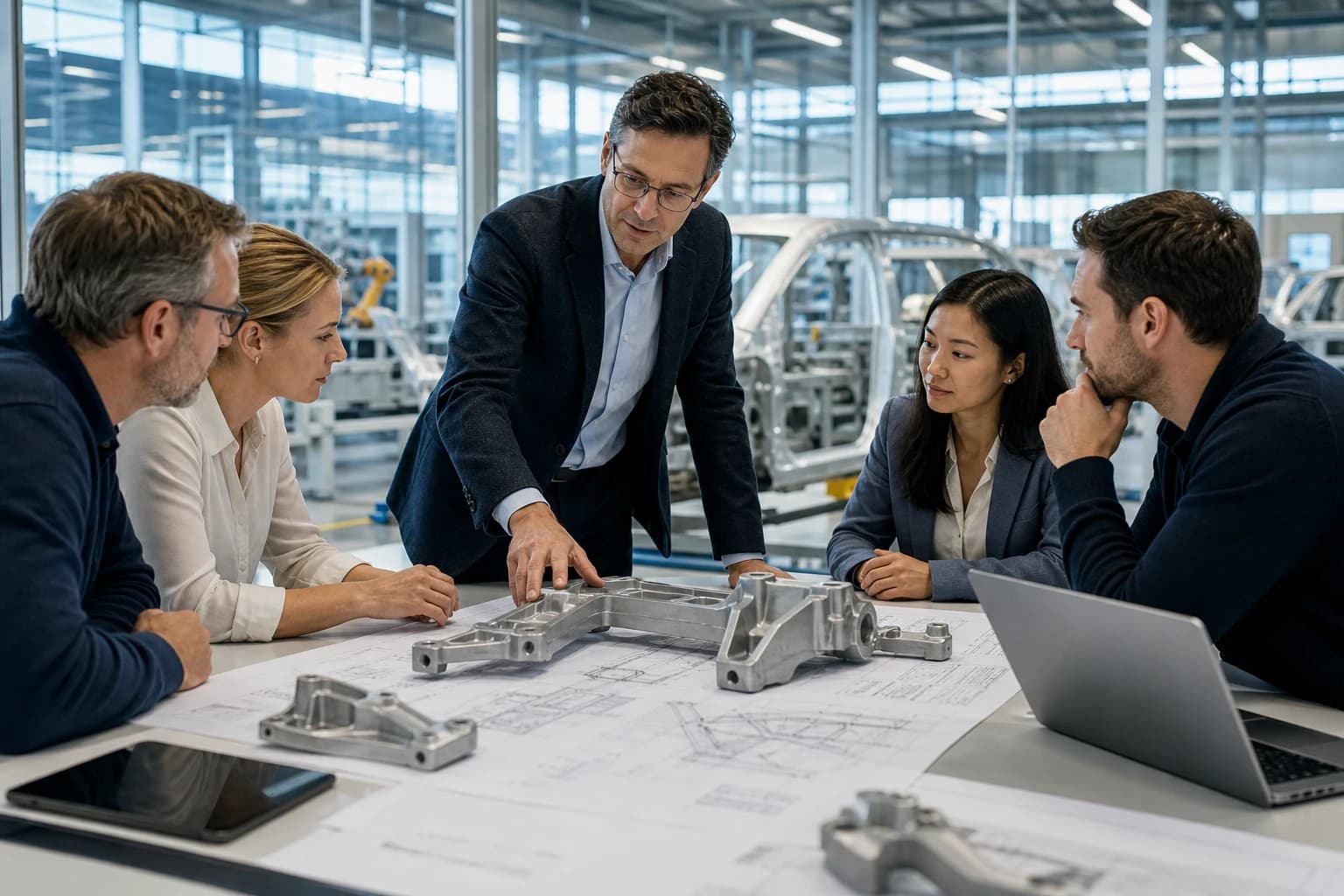
Based on Dr. Heiko Engels’ remarks, CTO of Kirchhoff Automotive, during the “Morning Briefing” on 28 October 2026 as part of the Livestage programme, and on discussions with other automotive industry representatives during IZB 2026 in Wolfsburg, Germany, several strategic priorities can be identified for the competitiveness of automotive suppliers.
1. Volume volatility and production flexibility
· Demand volatility is now one of the main critical issues for OEMs and Tier-1 suppliers.
· It is no longer sustainable to size all investments around the peak production capacity forecast at the start of a project.
· There is a need for gradual investments, aligned with the actual development of volumes.
For a Tier-2: the objective should be to enhance production flexibility, the ability to adapt volumes quickly, and industrial investments proportionate to demand.
2. Cost competitiveness and capital management
· Strong pressure on prices, energy costs and raw materials, especially aluminium and magnesium.
· Cash management and capital tied up in equipment and unused capacity are major critical issues.
· There is a need for more efficient industrial models and for reducing unnecessary upfront investments.
For a Tier-2: offer competitive solutions, with flexible industrialisation and focus on total costs.
3. Automation, quality and digitalisation
· Kirchhoff considers automation a key factor in the competitiveness of European plants.
· AI and the smart use of data can improve efficiency, productivity and decision-making speed.
· High quality standards, automation and technical skills make it possible to keep production competitive in Europe.
For a Tier-2: demonstrate process efficiency, industrial quality, technical expertise and the ability to improve continuously.
4. Partnerships and collaboration across the supply chain
· The importance of collaboration between companies is growing, to share expertise, resources and investments.
· The model in which each company develops all activities in-house is being left behind.
· Strategic partnerships are a tool to reduce costs and access new opportunities.
For a Tier-2: position yourself not only as a component manufacturer, but as a reliable technical-industrial partner capable of offering integrated solutions.
5. International competition and China
· Chinese competition is recognised as a significant challenge, especially on costs.
· Kirchhoff also sees cooperation with Chinese suppliers and OEMs as a possible opportunity.
· The group values an international network of skills and production activities to improve competitiveness.
For a Tier-2: differentiate through flexibility, proximity to the customer, quality, response times and overall competitiveness.
6. Market evolution and new opportunities
· Kirchhoff highlighted the presence at IZB of contacts from Volkswagen, Škoda, Porsche and Audi.
· New Chinese OEMs in Europe represent both a challenge and a possible opportunity.
· There is growing interest in diversifying markets and products to reduce dependence on traditional automotive volumes.
For a Tier-2: broaden the customer portfolio and maintain production capabilities applicable to different component families and markets.
The central message is that Tier-1 suppliers increasingly seek suppliers capable of combining competitiveness, quality, volume flexibility and limited capital employed.
For a Tier-2, these elements can be a basis for differentiation in discussions with Kirchhoff and other European Tier-1 suppliers, provided they are backed by concrete examples and industrial data.
A concrete issue to work through?
Start with the context. Then define the next step.
A no-obligation 30-minute conversation to understand priorities, constraints and room for action.
Share the context